Companies Act
Appointment of Director under Companies Act, 2013 (With Draft Formats)

Introduction
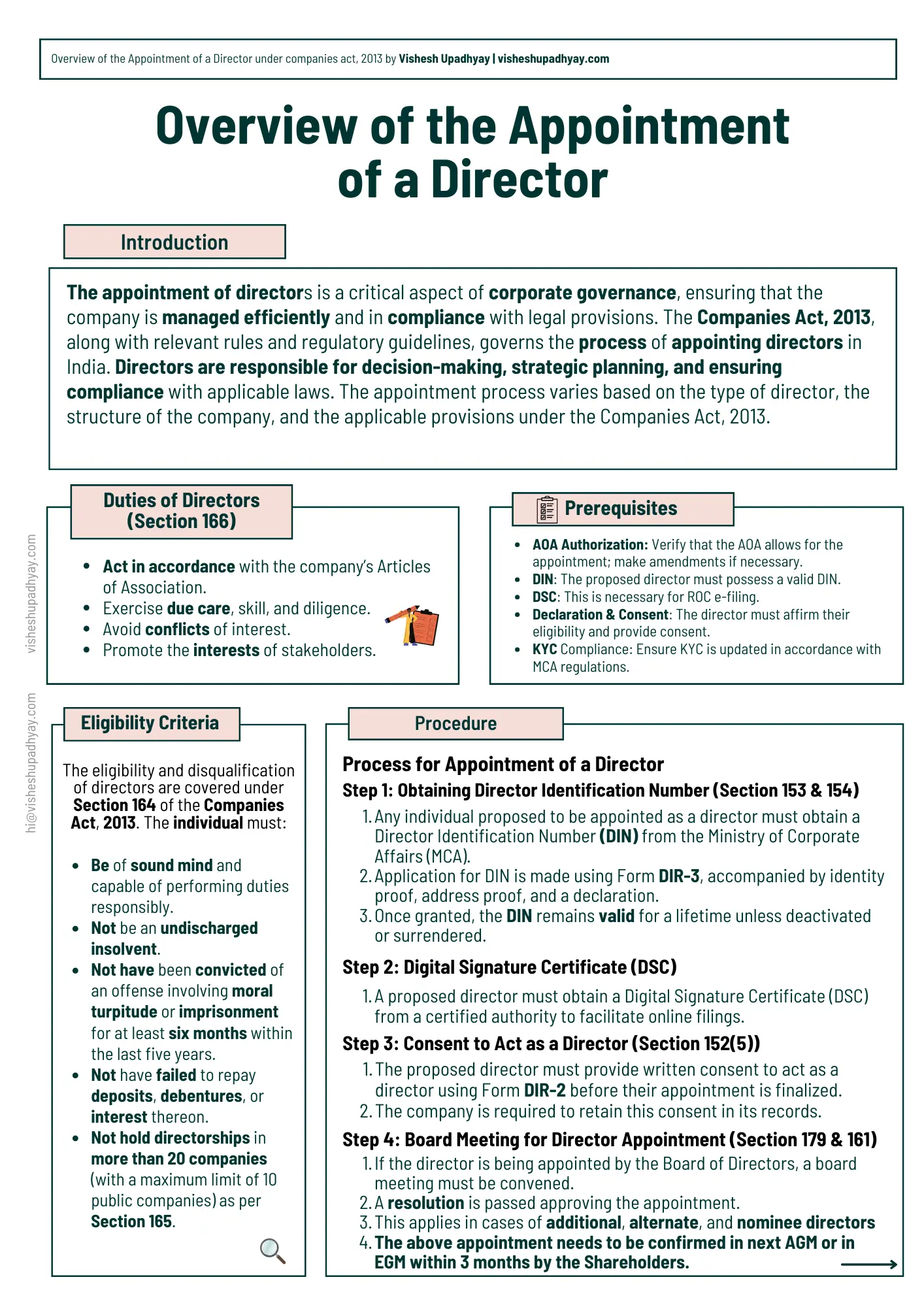
The Appointment of directors is a critical aspect of corporate governance, ensuring that the company is managed efficiently and in compliance with legal provisions. The Companies Act, 2013, along with relevant rules and regulatory guidelines, governs the process of appointing directors in India. Directors are responsible for decision-making, strategic planning, and ensuring compliance with applicable laws. The appointment process varies based on the type of director, the structure of the company, and the applicable provisions under the Companies Act, 2013.
About this Article
This article discusses the legal and procedural framework governing the appointment of directors under the Companies Act, 2013. It covers key aspects such as the prerequisites for appointment, eligibility criteria, types of directors, and the step-by-step process of appointment. Additionally, it highlights practical challenges, compliance requirements, and the consequences of non-compliance. The article aims to serve as a guide for companies, corporate professionals, and stakeholders involved in corporate governance.
Summarized PDF with Infographics
Download PDF
You may download the PDF and Word Files of Annexure/Formats of the Appointement of Directors as Companies Act, 2013.
The appointment of a director is a pivotal corporate event governed primarily by Section 152 of the Companies Act, 2013, read with the Companies (Appointment and Qualification of Directors) Rules, 2014. Whether you are structuring the board of a newly incorporated Private Limited Company or adding independent directors to a Listed Entity, strict adherence to statutory timelines and mandatory filings is non-negotiable.
This guide provides a comprehensive, step-by-step breakdown of the compliance requirements, the technical prerequisites for the Ministry of Corporate Affairs (MCA) portal, and the severe penalties for non-compliance under the latest regulatory framework.
Prerequisites for Appointment of Directors
Before proceeding with the appointment, companies must ensure compliance with the following prerequisites:
Articles of Association (AOA) Authorization: The company’s AOA must authorize the appointment process. If necessary, amendments should be made before the appointment.
Director Identification Number (DIN): The proposed director must have a valid DIN issued by the MCA.
Digital Signature Certificate (DSC): Required for filing electronic forms with the ROC.
Declaration and Consent: The proposed director must submit a declaration confirming eligibility and consent to act as a director.
KYC of Director: Updated KYC compliance for all directors, as required under MCA rules.
Digital Signature Certificate (DSC)
The proposed director must hold a valid Class 3 Digital Signature Certificate. This is a mandatory requirement, as all MCA forms (including the consent form DIR-2 and the eventual DIR-12) must be digitally signed. The DSC must be registered on the MCA V3 portal.
Director Identification Number (DIN)
Under Section 153 of the Companies Act, no person can be appointed as a director without a DIN.
- For New Incorporations: A maximum of 3 DINs can be applied for simultaneously through the SPICe+ (INC-32) form.
- For Existing Companies (The Form DIR-3 Requirement): A critical amendment introduced in 2018 mandates that an individual cannot apply for a DIN in isolation. To file Form DIR-3, the applicant must attach a Board Resolution from the existing company that proposes to appoint them. This ensures DINs are only allotted to individuals with a genuine, immediate intent to join a specific corporate board.
Phase 2: Mandatory Disclosures and Consents (Pre-Appointment)
To ensure the proposed director is legally eligible to hold the position, the company must collect several mandatory declarations before convening the Board Meeting.
Form DIR-2: Consent to Act as a Director
Pursuant to Section 152(5) and Rule 8, the proposed individual must provide their formal, written consent to act as a director in Form DIR-2. This document contains their personal details, occupational background, and DIN.
Form DIR-8: Declaration of Non-Disqualification
Under Section 164(2) of the Act, a person is disqualified from being appointed if they have previously been a director in a company that defaulted on filing financial statements or repaying deposits for three consecutive years. The candidate must submit Form DIR-8 declaring they are free from any such disqualifications.
MHA Security Clearance for Land Border Countries (Crucial 2022 Amendment)
If the proposed director is a national of a country that shares a land border with India (such as China, Bangladesh, Pakistan, Nepal, etc.), they are subject to strict Foreign Exchange Management Act (FEMA) and MCA regulations. The candidate must obtain prior security clearance from the Ministry of Home Affairs (MHA), Government of India. This clearance certificate must be physically attached to their DIR-2 consent form.
Eligibility Criteria for Appointment of Directors (Section 164 & 165)
The eligibility and disqualification of directors are covered under Section 164 of the Companies Act, 2013. The individual must:
- Be of sound mind and capable of performing duties responsibly.
- Not be an undischarged insolvent.
- Not have been convicted of an offense involving moral turpitude or imprisonment for at least six months within the last five years.
- Not have failed to repay deposits, debentures, or interest thereon.
- Not hold directorships in more than 20 companies (with a maximum limit of 10 public companies) as per Section 165. (Note: This limit includes alternate directorships but strictly excludes dormant companies and Section 8 not-for-profit companies).
Duties of Directors (Section 166)
- Act in accordance with the company’s Articles of Association.
- Exercise due care, skill, and diligence.
- Avoid conflicts of interest.
- Promote the interests of stakeholders.
Types of Directors under the Companies Act, 2013
Directors can be classified into various categories based on their roles and responsibilities:
- First Directors (Section 152(1)): Appointed at the time of company incorporation. They are usually named directly in the Articles of Association (AOA) and filed via the SPICe+ (INC-32) form. If not explicitly named, the individual subscribers to the memorandum are deemed to be the first directors.
- Executive Directors: Actively involved in the day-to-day operations of the company.
- Non-Executive Directors: Not involved in daily operations but provide guidance and oversight.
- Independent Directors (Section 149): Appointed in listed and certain unlisted public companies to provide unbiased oversight.
- Nominee Directors (Section 161(3)): Represent institutional investors or government entities.
- Additional Directors (Section 161(1)): Appointed by the Board if authorized by the Articles of Association (AOA), subject to confirmation at the next general meeting.
- Alternate Directors (Section 161(2)): Appointed to act in place of a director who is absent for more than three months.
- Small Shareholder Directors (Section 151): Appointed by small shareholders in listed companies.
5. Process for Appointment of a Director
Step 1: Obtaining Director Identification Number (DIN) (Section 153 & 154)
- Any individual proposed to be appointed as a director must obtain a Director Identification Number (DIN) from the Ministry of Corporate Affairs (MCA).
- Application for DIN is made using Form DIR-3, accompanied by identity proof, address proof, and a declaration.
- Once granted, the DIN remains valid for a lifetime unless deactivated or surrendered.
Step 2: Digital Signature Certificate (DSC)
- A proposed director must obtain a Digital Signature Certificate (DSC) from a certified authority to facilitate online filings.
Step 3: Consent to Act as a Director (Section 152(5))
- The proposed director must provide written consent to act as a director using Form DIR-2 before their appointment is finalized.
- The company is required to retain this consent in its records.
Step 4: Board Meeting for Director Appointment (Section 179 & 161)
If the director is being appointed by the Board of Directors, a board meeting must be convened.
A resolution is passed approving the appointment.
This applies in cases of additional, alternate, and nominee directors.
The Appointment of Director by Board is Required to be Approved by the Shareholders.
Timeline for Shareholder Approval:
- For Unlisted Companies: The appointment of an Additional Director by the Board must be approved by the shareholders at the next Annual General Meeting (AGM).
- For Listed Entities: Under Regulation 17(1C) of the SEBI (LODR) Regulations, listed entities must ensure that the appointment is approved by shareholders at the next general meeting or within 3 months from the date of appointment, whichever is earlier.
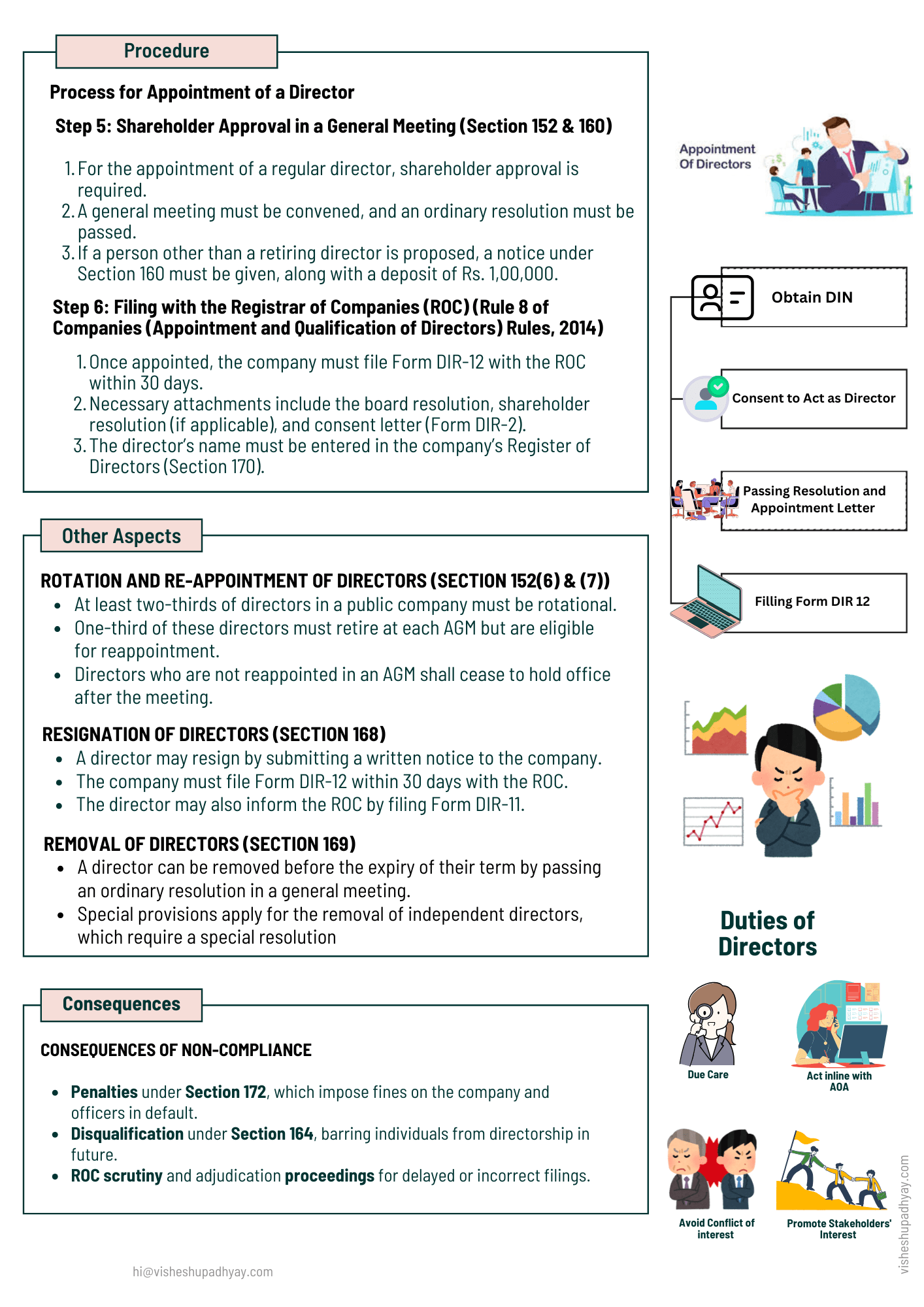
Step 5: Shareholder Approval in a General Meeting (Section 152 & 160)
For the appointment of a regular director, shareholder approval is required.
A general meeting must be convened, and an ordinary resolution must be passed.
If a person other than a retiring director is proposed, a notice under Section 160 must be given, along with a deposit of Rs. 1,00,000.
Crucial Exemption: Private Limited Companies are entirely exempt from the requirement of providing a notice and the ₹1,00,000 deposit under Section 160.
Step 6: Filing with the Registrar of Companies (ROC) (Rule 8 of Companies (Appointment and Qualification of Directors) Rules, 2014)
- Once appointed, the company must file Form DIR-12 with the ROC within 30 days.
- Necessary attachments include the board resolution, shareholder resolution (if applicable), and consent letter (Form DIR-2).
- The director’s name must be entered in the company’s Register of Directors (Section 170).
ROC Compliance and Form DIR-12 Configuration
This is the most critical compliance step. Under Section 170(2) of the Companies Act, the company must intimate the Registrar of Companies (ROC) about the new appointment.
Filing Form DIR-12
The company must file Form DIR-12 on the MCA portal within 30 days of the date of the board resolution.
Mandatory Attachments for DIR-12:
- Certified True Copy (CTC) of the Board Resolution.
- Signed Form DIR-2 (Consent).
- Signed Form DIR-8 (Declaration of Non-Disqualification).
- Letter of Appointment (Optional but recommended).
Professional Certification:Depending on the paid-up share capital and turnover of the company, Form DIR-12 may require digital certification by a practicing professional—a Chartered Accountant (CA), Company Secretary (CS), or Cost and Management Accountant (CMA)—verifying that the particulars in the form match the company’s statutory records.
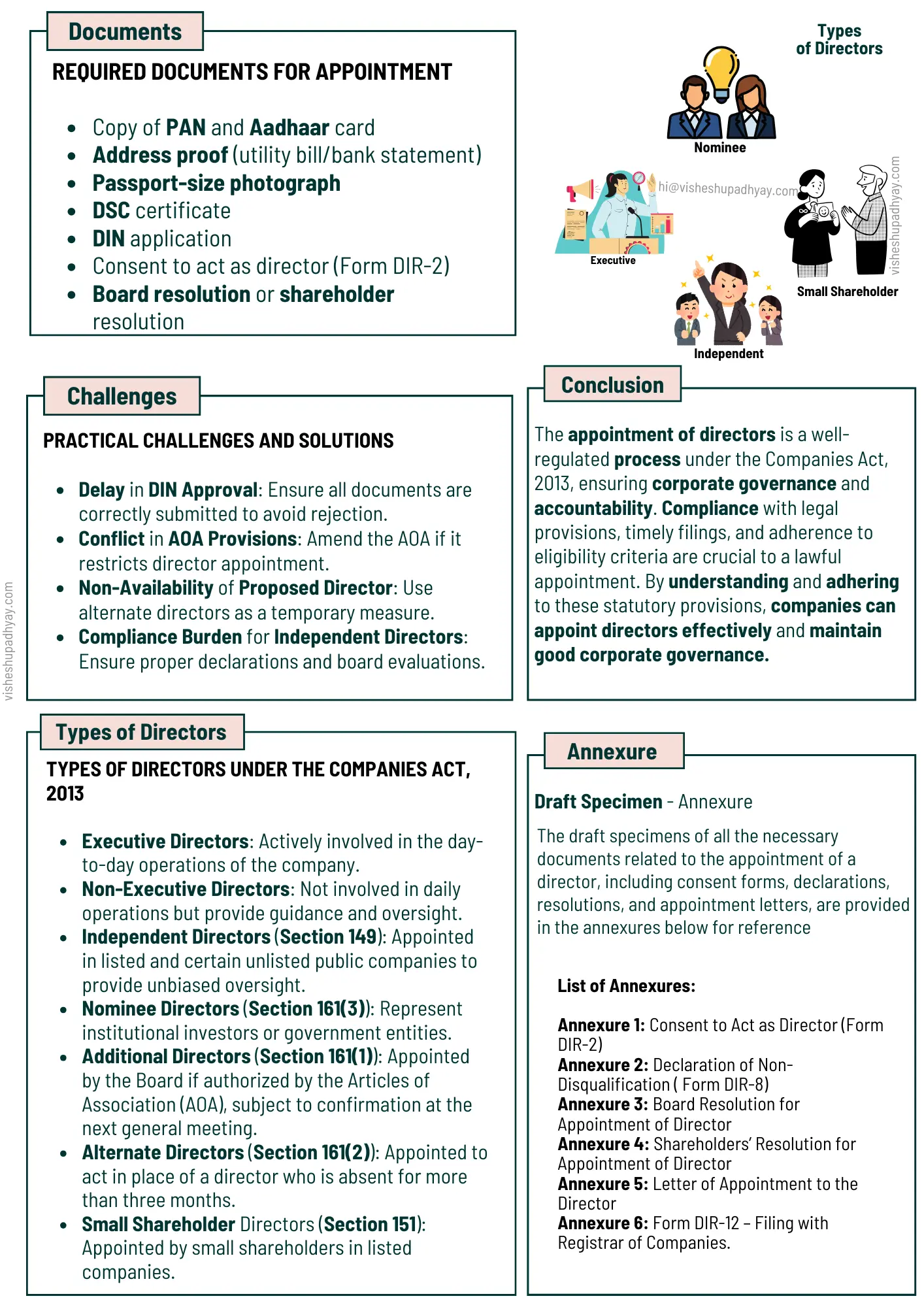
Required Documents for Appointment
- Copy of PAN and Aadhaar card
- Address proof (utility bill/bank statement)
- Passport-size photograph
- DSC certificate
- DIN application (if applicable)
- Consent to act as director (Form DIR-2)
- Board resolution or shareholder resolution
Practical Challenges and Solutions
- Delay in DIN Approval: Ensure all documents are correctly submitted to avoid rejection.
- Conflict in AOA Provisions: Amend the AOA if it restricts director appointment.
- Non-Availability of Proposed Director: Use alternate directors as a temporary measure.
- Compliance Burden for Independent Directors: Ensure proper declarations and board evaluations.
Rotation and Re-Appointment of Directors (Section 152(6) & (7))
- At least two-thirds of directors in a public company must be rotational.
- One-third of these directors must retire at each AGM but are eligible for reappointment.
- Directors who are not reappointed in an AGM shall cease to hold office after the meeting.
Removal and Resignation of Directors
1 Resignation of Directors (Section 168)
- A director may resign by submitting a written notice to the company.
- The company must file Form DIR-12 within 30 days with the ROC.
- The director may also inform the ROC by filing Form DIR-11.
2 Removal of Directors (Section 169)
- A director can be removed before the expiry of their term by passing an ordinary resolution in a general meeting.
- Special provisions apply for the removal of independent directors, which require a special resolution.
Consequences of Non-Compliance
Failure to comply with the appointment process can lead to:
- Penalties under Section 172, which impose fines on the company and officers in default.
- Disqualification under Section 164, barring individuals from directorship in future.
- ROC scrutiny and adjudication proceedings for delayed or incorrect filings.
Draft Specimen - Annexure
The draft specimens of all the necessary documents related to the appointment of a director, including consent forms, declarations, resolutions, and appointment letters, are provided in the annexures below for reference.
List of Annexures
- Annexure 1: Consent to Act as Director (Form DIR-2)
- Annexure 2: Declaration of Non-Disqualification ( Form DIR-8)
- Annexure 3: Board Resolution for Appointment of Director
- Annexure 4: Shareholders’ Resolution for Appointment of Director
- Annexure 5: Letter of Appointment to the Director
- Annexure 6: Form DIR-12 – Filing with Registrar of Companies
Download Annexure - Word File - Click here
Annexure 1: Consent to Act as a Director (Form DIR-2)
Form DIR-2
Consent to act as a director of a company
Pursuant to Section 152(5) and rule 8 of companies (Appointment and Qualification of Directors rules), 2014
To,
___ PRIVATE LIMITED
Subject: Consent to act as a Director.
I, Asif Husain, hereby give my consent to act as director of ___ PRIVATE LIMITED pursuant to sub-section (5) of Section 152 of the Companies Act, 2013 and certify that I am not disqualified to become a director under the Companies Act, 2013.
- Director Identification Number (DIN):
- Name (in full):
- Father’s Name (in full):
- Address:
- E-mail id:
- Mobile No.:
- Income-tax PAN:
- Occupation:
- Date of Birth:
- Nationality:
11.No. of companies in which I am already a Director and out of such companies the names of the companies in which I am a Managing Director, Chief Executive Officer, Whole time Director, Secretary, Chief Financial Officer and Manager.
- Particulars of membership No. and Certificate of practice No. if the applicant is a member of any professional Institute. N/A
Declaration
I declare that I have not been convicted of any offence in connection with the promotion, formation or management of any company or LLP and have not been found guilty of any fraud or misfeasance or of any breach of duty to any company under this Act or any previous company law in the last five years. I further declare that if appointed, my total Directorship in all the companies shall not exceed the prescribed number of companies in which a person can be appointed as a Director.
Signature: [Name of Director] [Date]
Attachments:
- Proof of identity;
- Proof of residence;
Annexure 2: Declaration of Non-Disqualification (Form DIR-8)
DECLARATION OF NON-DISQUALIFICATION UNDER SECTION 164(2) (Pursuant to Section 164(2) and Rule 14(1) of the Companies (Appointment and Qualification of Directors) Rules, 2014)
To, The Board of Directors [Company Name] [Company Address]
I, [Name], son/daughter of [Father’s Name], resident of [Address], having Director Identification Number (DIN): [DIN], hereby confirm that:
- I am not disqualified from being appointed as a director under Section 164(2) of the Companies Act, 2013.
- I have not been convicted of any offense and sentenced to imprisonment for a period exceeding six months.
- I am not debarred by SEBI or any other regulatory authority from holding the position of a director.
I affirm that the above declarations are true to the best of my knowledge.
Signature: [Name of Director] [Date]
Annexure 3: Board Resolution for Appointment of Director
[On the Company’s Letterhead]
BOARD RESOLUTION FOR APPOINTMENT OF DIRECTOR
CERTIFIED TRUE COPY OF THE RESOLUTION PASSED AT THE MEETING OF THE BOARD OF DIRECTORS OF [COMPANY NAME], HELD ON [DATE] AT [TIME] AT [VENUE].
“RESOLVED THAT pursuant to the provisions of Section 152 and other applicable provisions of the Companies Act, 2013, and the Articles of Association of the Company, Mr./Ms. [Name], having DIN: [DIN], who has provided his/her consent in writing to act as a director and has submitted the necessary declarations, be and is hereby appointed as a [Designation, e.g., Additional/Independent/Executive] Director of the Company with effect from [Date].”
“RESOLVED FURTHER THAT Mr./Ms. [Authorized Person’s Name], Director/Company Secretary of the Company, be and is hereby authorized to file the necessary forms with the Registrar of Companies and take all such steps as may be required in this regard.”
For and on behalf of [Company Name]
[Signature] [Name] [Designation] [Date]
Annexure 4: Shareholders’ Resolution for Director Appointment
[On the Company’s Letterhead]
ORDINARY RESOLUTION PASSED AT THE GENERAL MEETING
CERTIFIED TRUE COPY OF THE RESOLUTION PASSED AT THE [ANNUAL/EXTRAORDINARY] GENERAL MEETING OF [COMPANY NAME] HELD ON [DATE] AT [VENUE].
“RESOLVED THAT pursuant to the provisions of Sections 152, 160, and other applicable provisions of the Companies Act, 2013, Mr./Ms. [Name], having DIN: [DIN], who has consented to act as a director and meets the qualifications prescribed under the Act, be and is hereby appointed as a [Designation] Director of the Company, liable to retire by rotation/not liable to retire by rotation.”
For and on behalf of [Company Name]
[Signature] [Name] [Designation] [Date]
Annexure 5: Letter of Appointment to Director
[On the Company’s Letterhead]
To, [Name of Director] [Address]
Subject: Appointment as Director of [Company Name]
Dear [Name],
We are pleased to inform you that the Board of Directors of [Company Name] has approved your appointment as a [Designation] Director of the Company in its meeting held on [Date], subject to shareholders’ approval at the upcoming General Meeting.
Your appointment is effective from [Date] and will be governed by the provisions of the Companies Act, 2013, and the Articles of Association of the Company.
We look forward to your contribution to the success of the company.
Yours sincerely, For [Company Name]
[Signature] [Name] [Designation] [Date]
Annexure 6: Form DIR-12 – Filing with Registrar of Companies
This is an e-Form filed with the MCA portal V3 Form DIR 12. The details required include:
- Company Name & CIN
- Director’s Name & DIN
- Type of Appointment
- Board Resolution details
- Attachments: DIR-2, DIR-8, and Board Resolution
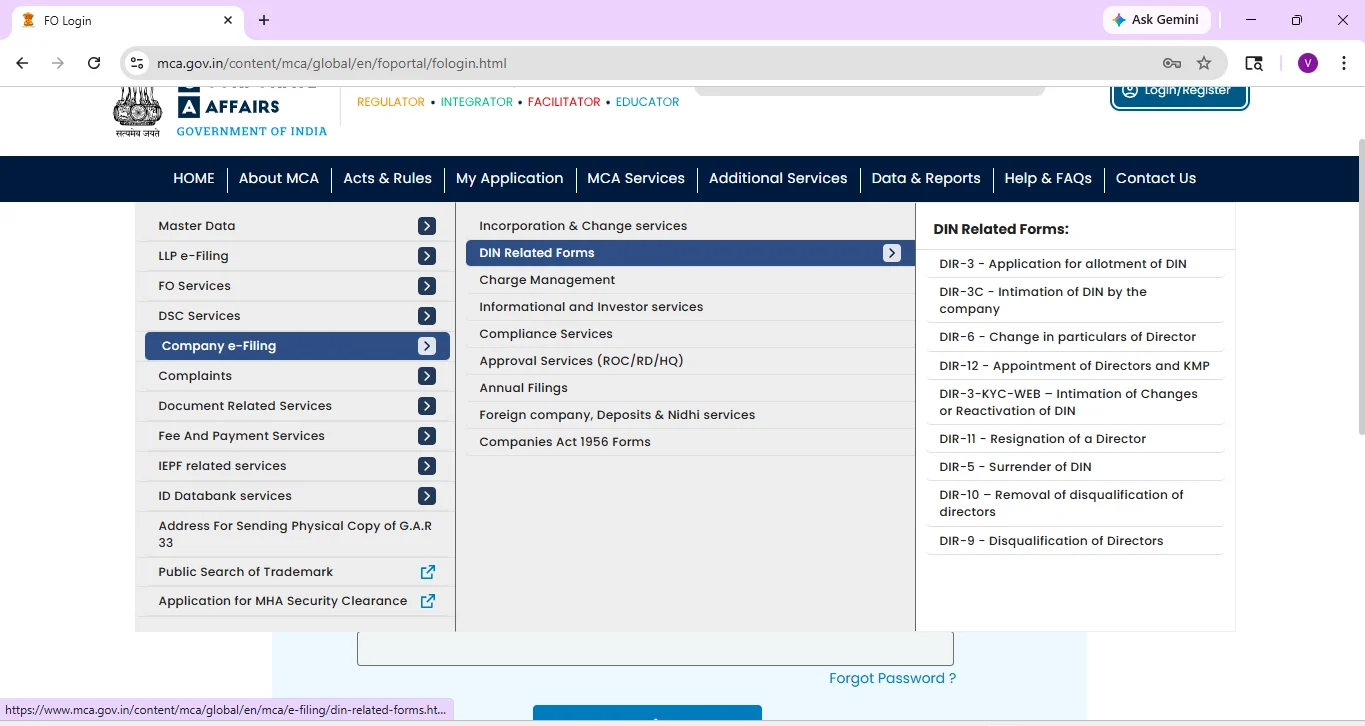
MCA PORTAL
MCA SERVICES > COMPANY EFILLLING > DIN RELATED SERVICES > DIR 12
Download Annexure - Word File and PDF Infographics
Post-Appointment Governance & Registers
The legal responsibilities do not end once DIR-12 is approved. The company and the new director must execute post-appointment compliance.
1. Disclosure of Interest (Form MBP-1)
Under Section 184(1), the newly appointed director must disclose their concern or interest in any other companies, bodies corporate, firms, or other associations of individuals. This disclosure must be made in Form MBP-1 at the very first Board Meeting in which they participate as a director.
2. Updating Statutory Registers
The company is legally bound to update its statutory registers maintained at its registered office:
- Register of Directors and Key Managerial Personnel (Section 170).
- Register of Contracts or Arrangements in which Directors are Interested in Form MBP-4 (Section 189).
3. Director KYC (DIR-3 KYC)
Under the Companies (Appointment and Qualification of Directors) Rules, every individual holding a DIN must complete their KYC.
Following recent MCA amendments effective from 2026, routine KYC filing is required every three consecutive financial years via the DIR-3 KYC-Web service. However, any change in the director’s personal details (email, mobile, address) triggers an immediate event-based KYC requirement.
Regularization at the Annual General Meeting (AGM)
As noted in Phase 3, an Additional Director’s tenure expires at the upcoming AGM. To permanently induct them into the company, their appointment must be “regularized.”
Under Section 152(2), the Board must recommend the director’s regular appointment to the shareholders. During the AGM, the shareholders pass an Ordinary Resolution to appoint the individual as a regular Director. Following this, another Form DIR-12 must be filed with the ROC within 30 days to reflect the change in designation from “Additional Director” to “Director.”
The Penalty Matrix: Why Timely Filing is Critical
A common misconception is that delaying DIR-12 only results in standard MCA late fees (which accrue at ₹100 per day). However, failing to file within 30 days is a direct violation of Section 170(2), which triggers the adjudication mechanisms under Section 172.
Standard Additional Fees
Filing between 31 and 300 days will attract additional filing fees based on the delay slab prescribed in the Companies (Registration Offices and Fees) Rules, 2014.
Adjudication Penalties under Section 172
If the MCA initiates adjudication proceedings for a Section 170(2) violation, the penalties are severe:
- The Company: Liable for a base penalty of ₹50,000, plus ₹500 for every day the default continues, subject to a maximum of ₹3,00,000.
- Officers in Default (Existing Directors): Each officer in default is liable for a base penalty of ₹50,000, plus ₹500 per day, subject to a maximum of ₹1,00,000 per individual.
Recent Example: In late 2023, the MCA imposed a penalty exceeding ₹4.5 Lakhs on a company and its directors specifically for a 208-day delay in filing Form DIR-12 for a new director appointment.
Conclusion
The appointment of directors is a well-regulated process under the Companies Act, 2013, ensuring corporate governance and accountability. Compliance with legal provisions, timely filings, and adherence to eligibility criteria are crucial to a lawful appointment. By understanding and adhering to these statutory provisions, companies can appoint directors effectively and maintain good corporate governance.
Frequently Asked Questions (FAQs)
- Can a Private Limited Company have only one director?
No. Under Section 149(1) of the Companies Act, 2013, a Private Limited Company must have a minimum of two directors. Only a One Person Company (OPC) is permitted to operate with a single director. The maximum number of directors allowed is 15, which can be increased by passing a Special Resolution.
- Is a full-time Company Secretary required to certify the DIR-12 for director appointment?
A full-time Company Secretary is only mandated for Private Limited Companies that have a paid-up share capital of ₹10 crore or more. If the company falls below this threshold, the DIR-12 form can be digitally signed by an authorized director and certified by a practicing professional (CA, CS, or CMA in practice).
- What happens if a director’s DIN is deactivated?
If a director fails to file their DIR-3 KYC within the statutory deadline, the MCA will deactivate their DIN. A deactivated DIN means the individual cannot be appointed to any new companies, and existing companies will face compliance roadblocks. The DIN can be reactivated by filing the KYC form along with the prescribed penalty fees.
- Are Private Company directors liable to retire by rotation?
No. Section 152(6) of the Companies Act, 2013, which mandates that two-thirds of directors must be liable to retire by rotation, strictly applies to Public Companies. Private Companies are completely exempt from rotational retirement unless their own Articles of Association explicitly require it.
- Can a foreign national be appointed as a director in an Indian company?
Yes, foreign nationals can be appointed, provided they obtain a DIN, a Class 3 DSC, and submit a notarized/apostilled passport and address proof. However, the company must ensure compliance with Section 149(3), which requires at least one director on the Board to be an Indian Resident (having stayed in India for not less than 182 days during the financial year).
##Quiz
Appointment of Directors Quiz
1. Who appoints the first directors of a company?
2. As per the Companies Act, 2013, what is the maximum tenure of an independent director?
3. Which form is required to be filed with the Registrar of Companies for the appointment of a director?
4. What is the minimum number of directors required for a public company?
5. Which of the following is not a type of director under the Companies Act, 2013?
6. What is the minimum age requirement for a director as per the Companies Act, 2013?
7. Which regulatory body oversees the appointment of directors in listed companies?
8. Who appoints an Additional Director in a company?
9. Under which section of the Companies Act, 2013, can a company remove a director?
10. What is the minimum percentage of independent directors required on the Board of a listed company?
Quiz Answers and Explanations
1. Who appoints the first directors of a company?
Correct Answer: The Subscribers to the Memorandum
The first directors of a company are appointed by the subscribers to the memorandum at the time of incorporation.
2. As per the Companies Act, 2013, what is the maximum tenure of an independent director?
Correct Answer: 5 years per term
An independent director can hold office for a maximum term of 5 years, and can be reappointed for another 5-year term, subject to approval.
3. Which form is required to be filed with the Registrar of Companies for the appointment of a director?
Correct Answer: DIR-12
Form DIR-12 is used to notify the Registrar of Companies (ROC) about the appointment or resignation of a director.
4. What is the minimum number of directors required for a public company?
Correct Answer: Three
A public company must have at least three directors as per the Companies Act, 2013.
5. Which of the following is not a type of director under the Companies Act, 2013?
Correct Answer: Shareholder Director
While shareholders may appoint directors, there is no specific designation called 'Shareholder Director' under the Companies Act, 2013.
6. What is the minimum age requirement for a director as per the Companies Act, 2013?
Correct Answer: 18 years
As per the Companies Act, a person must be at least 18 years old to become a director of a company.
7. Which regulatory body oversees the appointment of directors in listed companies?
Correct Answer: SEBI
The Securities and Exchange Board of India (SEBI) regulates the appointment of directors in listed companies to ensure corporate governance.
8. Who appoints an Additional Director in a company?
Correct Answer: Board of Directors
The Board of Directors has the power to appoint an additional director, subject to shareholder approval in the next general meeting.
9. Under which section of the Companies Act, 2013, can a company remove a director?
Correct Answer: Section 169
Section 169 of the Companies Act, 2013, provides the procedure for removing a director before the expiry of their term.
10. What is the minimum percentage of independent directors required on the Board of a listed company?
Correct Answer: 50% (if the Chairman is non-independent)
If the Chairman of a listed company’s board is a non-independent director, then at least 50% of the board must consist of independent directors.